Research Facilities
Our laboratory is equipped with the following instruments for toxicological strudies and metabolomics research.

LC - MS/MS
Sciex ExcionLC - Tendem mass API 3200
Liquid Chromatography-Tandem Mass Spectrometry is used for sensitive and selective chemical analysis. In our laboratory, it is applied to trace residue analysis, targeted compound quantification, and metabolomic profiling. The technique also allows precursor ion selection and fragmentation analysis for structural identification of compounds and their metabolites.
LC - MS/MS
Sciex LC - Tendem mass API 3200
Liquid Chromatography-Tandem Mass Spectrometry is used for sensitive and selective chemical analysis. In our laboratory, it is applied to trace residue analysis, targeted compound quantification, and metabolomic profiling. The technique also allows precursor ion selection and fragmentation analysis for structural identification of compounds and their metabolites.

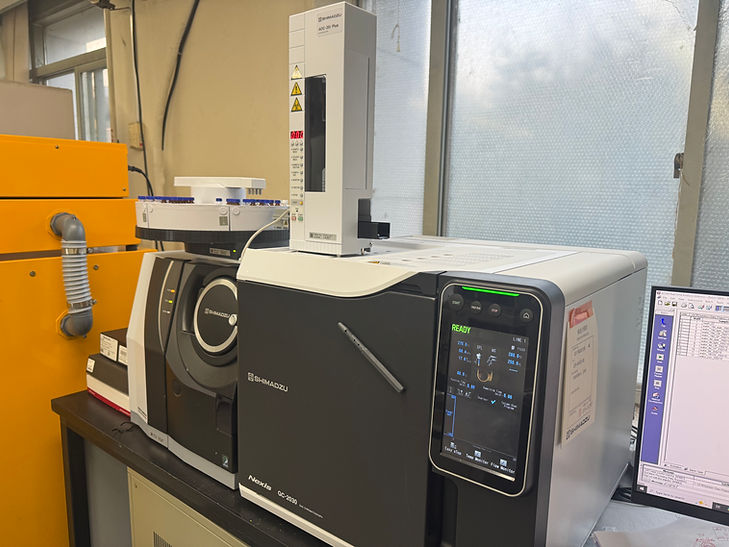

GC - MS/MS
Nexis GC - 2030 / GCMS - TQ8050NX
Gas Chormatogrphy-Tandem Mass Spectrometry is an analytical technique that combines gas chromatographic separation with tandem mass spectrometric detection for highly sensitive and selective analysis of volatile and semi-volatile compounds. In our laboratory, GC–MS/MS is widely used for the analysis of trace volatile residues, quantitative determination of individual compounds, and profiling of primary metabolites. The system is also applied to the analysis of fatty acids, sterols, and hormones, enabling detailed investigation of biochemical changes and metabolic processes.
GC - MS
GCMS-QP2010 SE
Gas Chromatography - Mass Spectrometry is an analytical technique that combines gas chromatographic separation with mass spectrometric detection for the identification and characterization of volatile and semi-volatile compounds. In our laboratory, GC–MS is primarily used for the analysis of fatty acids and sterols, as well as for evaluating the purity of synthesized chemical compounds. The system is also utilized to investigate fragmentation patterns, enabling structural confirmation and detailed characterization of chemical structures.


GC - FID & ECD
Agilent technology GC system (G2397AD)
Gas Chromatography with Flame Ionization Detection and Electron Capture Detection is an analytical technique used for the sensitive detection of compounds containing carbon chains and halogenated molecules. In our laboratory, GC–FID/ECD is primarily applied to the analysis of halogen-containing pesticide compounds and their metabolites. The system is also utilized for the quantitative analysis of fatty acids composed of carbon chains, enabling reliable detection and characterization of these compounds in various samples.
Shaking Incubator
The shaking incubator is used for microbial cultivation in studies investigating antibacterial and antifungal activity. It enables the growth of microorganisms under controlled temperature and agitation conditions, facilitating the evaluation of bioactive compounds. In particular, it is utilized for culturing microorganisms that produce natural substances with antibacterial and antifungal properties.


Plant Growth House
Greenhouse Facility provides a controlled environment for plant growth experiments and seed germination studies. In our laboratory, this facility is used to investigate the effects of toxic compounds, natural products, and synthetic chemicals on seed germination and early seedling development. Through controlled exposure experiments, we evaluate how these substances influence plant growth and physiological responses during the early stages of plant development.